

Open Source in Local Government: Twelve Years of Experience from a Municipal Office
15/11/2026
The Ministry of Digital Affairs has announced PLN 10 million for local governments to pilot open-source software implementations. The announcement coincided with another global outage of Microsoft services. I work as an IT specialist at the Municipal Office in Stary Sącz, and we've been using open source here for twelve years.
This text is not an advertisement or a manifesto. It's a balance: what works, what didn't turn out, and what needs to be changed so that open source software in administration stops being a niche.
Why this topic right now
At the turn of the year, municipalities will be able to submit applications for a grant competition on open-source pilot projects. The funds come from the European Funds for Digital Development program. The Ministry is also announcing an office for open-source software programs and a public repository for administration.
According to the data cited in this context, over 83 percent of entities already use open source on a limited basis. Deputy Prime Minister Krzysztof Gawkowski spoke about the risk of dependence on global suppliers during the outage. The PAP Local Government Service reported the announcement.
This risk is not theoretical. In July 2024, a flawed CrowdStrike software update grounded around 8.5 million Windows computers, bringing airports, banks, and hospitals to a standstill. Business Insider summarized the effects of that outage.
How it started
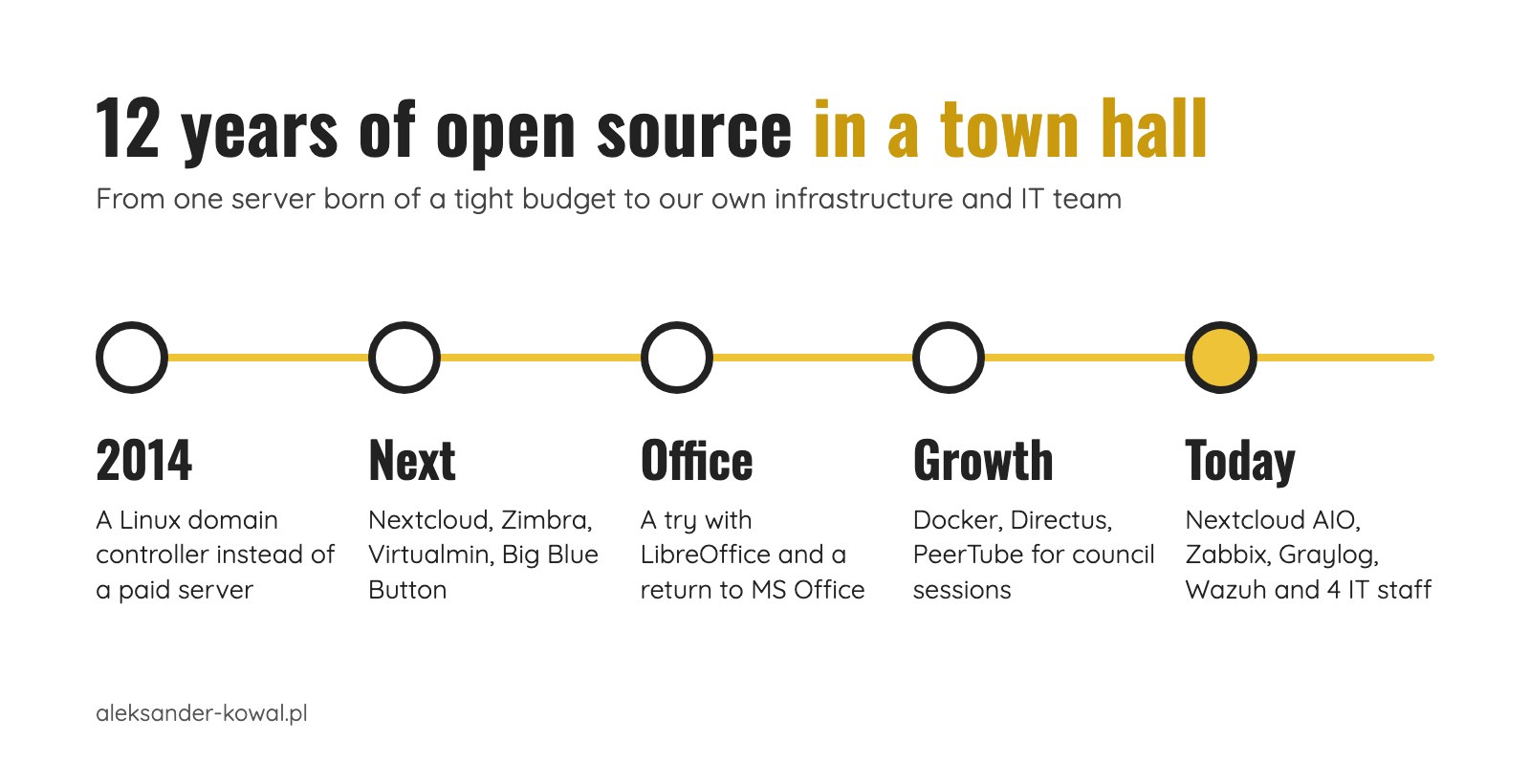
There was no strategy or resolution. In 2014, there was a lack of budget and a need. The first step was a Linux domain controller instead of a paid Windows server.
It worked, so we kept going. Over time, more services were added and the team grew from one person to four IT specialists. Today, our own server room hosts, among others:
- Nextcloud AIO: files, calendars and video calls, previously Big Blue Button
- PeerTube: live streams and archive of council sessions
- Directus: intranet and internal applications
- Docker as the foundation of most services
- Zabbix, Graylog and Wazuh: monitoring, logs and threat detection
- open libraries for building the office's websites and applications
Along the way, there was also Zimbra, Virtualmin on hosting, and the first workstations with LibreOffice. Not everything survived, but each of these implementations taught us something.
 (enlarge)
What it gave us
Data under our own roof
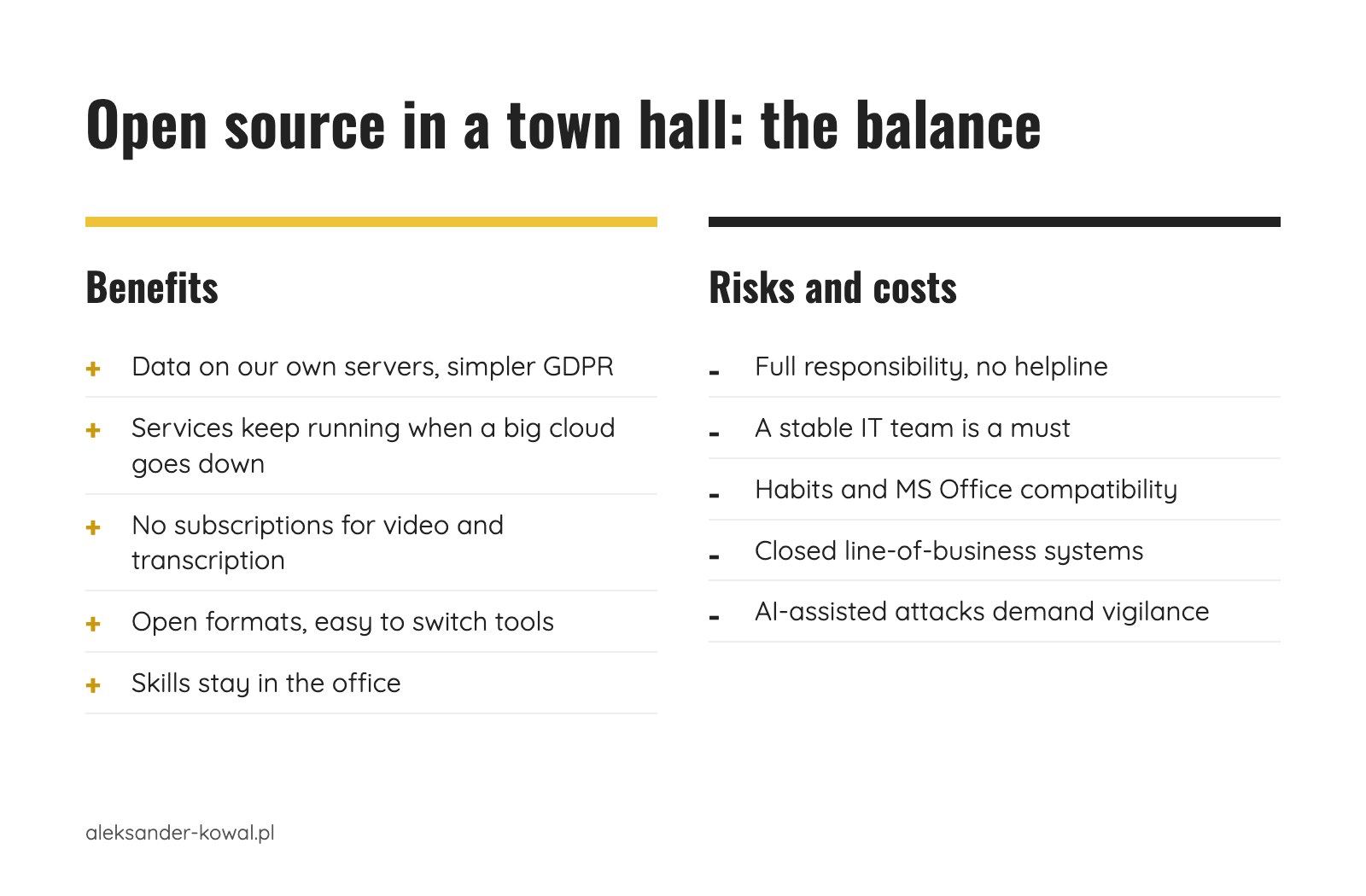
Documents, recordings, and logs are stored on our servers. We know where they are, who has access to them, and how to retrieve them. We take great care of backups and regularly verify that everything can be restored from them.
With GDPR, it's a huge convenience. We don't have to analyse where the data ends up or what the provider will do with them tomorrow.
Independence from a single supplier
When a large cloud provider has an outage, our services continue to operate smoothly. If the provider changes their pricing or license terms, we can switch tools easily because our data is stored in open formats.
Tangible savings
The best example is council session streams on PeerTube. We don't pay for video hosting subscriptions or transcriptions, and the recordings aren't subject to the rules of a third-party platform. Similarly, Nextcloud replaces paid file sharing and online meeting services.
Skills stay in the office
This benefit is the least visible but, in my opinion, the most important. A team that maintains systems on its own understands them and can react. It doesn't wait for a report from an external company.
Where things didn't work out
The office suite
Implementing LibreOffice was our toughest lesson. Officials had been learning on Microsoft Office for years, often since school. Plus, there was the issue of document incompatibility when exchanging with other entities.
In the end, we went back to MS Office. Not because LibreOffice is bad, but because one office won't change the habits of the entire administration. This is today's biggest hurdle for open source in local government.
Line-of-business systems
Accounting, HR, taxes and records are run on closed systems like Bestia or Płatnik. They require Windows, Java, and commercial databases. A few companies dominate this market, controlling most of the municipalities. An individual office has no alternative here.
Responsibility and people
Having your own infrastructure means taking on your own responsibility. There is no helpline to blame when things go wrong. You have to update, monitor, and test backups, even outside of working hours.
Without a stable IT team, open source becomes a risk. For the first few years, everything relied on one person, which was our weakest point.
 (enlarge)
Security in the age of AI
A common argument against open source is: the code is public, so it's easier to attack. In practice, public code is reviewed by thousands of people, and vulnerabilities are quickly patched. Closed systems also have vulnerabilities, but we just don't know about them.
However, artificial intelligence is changing the scale of the problem. Attackers are finding vulnerabilities faster and crafting more convincing phishing emails. Therefore, maintaining your own server room today requires more vigilance than it did ten years ago.
For us, this means:
- regular updates and event monitoring in Wazuh and Graylog
- internal and external audits
- backups from which we regularly test restoration
- GDPR procedures and the principle of least privilege access
For the same reason, municipalities rarely share their solutions. They fear that describing infrastructure will make an attack easier. This caution is understandable, but it blocks cooperation, which local governments need most.
Schools: free was only the start
In November 2026, Microsoft announced that it is withdrawing free email and collaboration tools for students. The change will affect schools at their first contract renewal on or after 1 January 2028. The Register reported the new rules.
The new free plan doesn't include email, Teams, or SharePoint. It will only be available to schools that pay for teacher licenses, and students must use Windows. Schools with Chromebooks are left empty-handed.
For municipalities, this is not a distant issue. They run primary schools and in a year they may face a bill or face the need to migrate thousands of accounts.
It can be done. Several Swiss universities migrated to Nextcloud in one weekend: nearly 40,000 people and 585 TB of data. Germany is building a public cloud for education using Nextcloud. It's the same tool we've been using at the office for years.
Schools have a year to make their decision. This is a good time for municipalities to plan it together rather than each negotiating individually with one supplier.
What's missing for it to work more widely
10 million PLN for pilot projects is a good sign, but licenses are not the main cost. People are the cost. Most small municipalities have one IT person or an external company for a few hours a month.
In my opinion, there is a need for:
- continuous funding for IT positions rather than one-off implementations
- shared solutions maintained centrally or by associations of municipalities
- open formats and interfaces in public procurement
- breaking the monopoly in line-of-business systems by requiring open APIs and data export
- a place where municipal IT professionals can safely exchange experiences
The announced public repository could be such a place, provided that it includes working code with instructions rather than just a list of recommendations.
Advice for those who want to start
Start with one service that solves a real problem. File sharing, monitoring, or live streaming of sessions are good places to begin. Leave the office suite for last.
It's a lot of work and rarely does anyone thank you for it. I wrote about this in my piece on the prevention paradoxBut it gives something that can't be bought in any tender: experience, satisfaction, and protection against professional stagnation.
Technological independence of an office doesn't start with a purchase. It begins with people who understand their systems.
- Aleksander Kowal
Was this useful?
New posts by e-mail
Every now and then, when a new post or project goes up. No ads.
Got an idea, a question or a comment? Write to me:Enable JavaScript to see the e-mail address